Friday, 2 October 2015

New buses for TM Travel

It's not just trentbarton that has new toys to play with this week.


The exciting news at TM is that we have today received three new Optare Solos, for use on Line 6 in Sheffield.  With 37 seats they offer a good capacity in a tried and tested model.  The red moquette provides a warm and welcoming ambience, and indeed is now our 'standard' moquette, being gradually applied to vehicles when they have a need for retrim.  Indeed, seat trim enthusiasts may note that the Peak Line 218 buses have a moquette that is identical, just in blue.  The buses don't feature exicting gizmos such as USB and wi-fi because the average customer journey time is very short, but they are very smart and tidy and provide a very light, spacious environment for customers.


For those that care about such things, they are YJ65 EPC, EPD and EPE.  Notts & Derby are also taking one new Solo for University of Derby work, which I suspect will be EPF.

Since the relaunch of Sheffield's Line 30 with new Versas in early 2014, we have pursued a policy of identifying our key routes across the network with their own brand and colours.  Line 30 was followed by Rotherham's Line 31, Sheffield's Line 4, Peak Line 218 and latterly Spira.

I am occasionally asked why we do this, and why we don't just paint everything red.  The answer is quite straightforward.

The way the Partnership arrangements are developing in South Yorkshire mean that there is much greater emphasis on the overall public transport network, rather than individual operators' own networks.  The PTE rightly places a high value on network stability and giving customers access to the whole network, and as such the value of promoting the company brand diminishes.  Our portfolio of routes in Sheffield and Rotherham is quite disparate, and we are not really a network operator as such.  If you just looked at the TM Travel network in isolation, you would see lots of gaps.

Therefore, we perceive that it is more important for customers to be able to identify individual routes within the overall bus network rather than that a route is a TM Travel route as such.  Customers tend to like familiarity so if we can give them something that they recognise as being theirs, and to which they develop loyalty, that benefits them and it benefits us.

We have used orange, yellow, maroon, green and blue on various routes now, so when we discussed what colour to apply to the Line 6 buses when they were being ordered, the management team came up with purple.  I mention this because some scurrilous people might feel that the colour looks vaguely familiar, so I'm at pains to point out that the decision to go for purple wasn't mine.  Although that decision having been made, I might have influenced which shade to adopt....

The buses have come a little earlier than I was expecting, so we don't yet have the livery vinyls but they shouldn't be too far away.  One slight spanner in the works is that when we ordered the buses, Line 6 had a PVR of three (as it does now) hence why we have three buses.  However, the Sheffield network review has resulted in a welcome extension of the 6 from 1st November to Abbeydale Tesco via the Royal Hallamshire Hospital, Hunters Bar and Carter Knowle Road.  This obviously increases the vehicle requirement so the route won't be run exclusively by new buses - we will have to repaint at least one existing Solo to complete the brand.

In other fleet news, we are in the process of restoring to service three MAN/Plaxton Centros 1197, 1199 and 1200 that have been seen in TM before and have wandered round the group looking for a loving home for a few years now.

MANs are an acquired taste but our Engineering Manager has a good track record of making them work in other places, and indeed is a brilliant investigative engineer who - when confronted with a troublesome bus - will stop at nothing until he identifies and cures the root of the problem.  I am therefore highly optimistic that we will make a success of these vehicles.

They are '08 registered, and with the three new Solos will make significant inroads into the non-DDA compliant W-reg Solos that need to leave the fleet by the end of the year, and in doing so will dramatically improve the fleet age profile.

Thursday, 1 October 2015

Stealing the show


This beautiful beast was the centre of attention at Coach and Bus Live at the NEC today.

One of a fleet of nine acquired by trentbarton for the Red Arrow express Derby - Nottingham route.  This is a brand that has grown and grown over many years from a standing start, and now operates every ten minutes throughout the day with journeys into the early hours on Friday and Saturday nights, an incredible service level that stands as a tribute to the operating staff who operate it, the control and engineering staff who support it and the management team and directors who have invested in continual improvements in the fleet and service levels.

These coaches replace a mixed fleet of 2004 Scania/Irizar InterCentury and 2010 Scania/Irizar i4 and take the style and comfort of the brand to a new level.

In technical terms, these are Volvo B11R Plaxton Elites with 57 seats (or 55 plus a wheelchair).

For the comfort of customers they feature a Brusa seat of a kind normally used on touring coaches, incorporating fold-down seat-back tables which include a cup holder and even a slot to prop up one's tablet.

It has been my pleasure to work with trentbarton MD Jeff Counsell and his management team and the unparalleled creative team of Best Impressions, firstly to select the marque of coach to buy and secondly to specify the design.

The project to buy new coaches for Red Arrow was initiated before my involvement with trentbarton, with a decision made in principle around this time last year that 2015 would be the year for new coaches.

The existing coaches are very comfortable and smooth to ride on and have served the brand very well, but are now starting to show their age - especially the 2004 batch.  I don't have the figures to hand but I reckon those must have done over a million miles each since entering service, an incredible figure.

However, the challenge was to know what to buy to replace them.  Over last winter it was clear that there were times when we were struggling to carry the numbers of people wishing to travel with duplicate journeys often running at peak times.  A timetable change earlier this year which improved reliability has helped that somewhat by ensuring that coaches don't bunch and the interval between journeys is about right - especially for those waiting at QMC for example - but even so it was clear that more, rather than less, capacity was needed.  And of course since it's a brand that trades on quality, this capacity could not be provided at the expense of comfort.

The need for wheelchair access is of course a given, but again care was needed to ensure that the wheelchair could be accommodated in a way that was not detrimental to the journey quality for either the wheelchair user or other passengers and again without compromising too much on capacity.

A number of different types of 12 metre coach were tried, with varying degrees of success, and indeed some very good ones among them.  But none quite ticked all the boxes.  Either they weren't right mechanically, or they didn't have enough capacity, or they simply lacked the 'wow' factor that a brand like Red Arrow commands.

We got quite excited by the possibility of an 'interdeck' design, of a kind offered by Van Hool or in the form of the Plaxton Elite i in widespread use with Megabus, or Go-Ahead on their X90 Oxford - London route for example, .  This concept places the seats on a higher level than a conventional coach so that they occupy the full length of the coach, coming forward of the driver, but with only luggage space below without room for a conventional lower deck.

We felt that these would really turn heads and provide a stunning advert for the brand, as well as providing a highly attractive customer environment.  For a long time the interdeck concept seemed to be the way we'd go.

However, on a visit to Oxford to sample the Go-Ahead Elite i, we were stood in Gloucester Green Bus Station when a 14 metre Elite operated by Stagecoach rolled in on their X5 Cambridge - Oxford route.  The driver kindly allowed us to have a look round.  We were immediately struck by the spacious entrance and indeed the sense of space throughout the saloon.

We then stumbled across a major problem with the interdecks.  On both the Plaxton and Van Hool designs, the wheelchair position was right next to the driver at the front downstairs.  This posed a number of issues.  Firstly, it's hardly a very dignified experience for the wheelchair user, being isolated from the rest of the customers and having to sit awkwardly alongside the driver.  Secondly, even with no wheelchair present the support framework was positioned right where we would want a customer to be able to stand to interact with the driver and buy tickets.

As much of trentbarton's success hinges on the relationship between the driver and the customers, it was not really acceptable to have to work round this obstacle placed right where the customers would want to stand.

It's a different proposition on a longer distance express service where the ticketing is often taken care of at the kerbside, so there is nothing at all wrong with the concept, it just wasn't right for Red Arrow.  Finally, the low height of the bottom deck meant that taller customers would have to stoop to enter the vehicle, which again is hardly conducive to the kind of welcome we would wish to project.

Not only did the entrance to the conventional Elite strike as as much more spacious and welcoming, the ingenious wheelchair lift hidden behind the steps meant that a wheelchair passenger could be accommodated within the saloon on the same level as the rest of the passengers.

So the decision was made to proceed with nine Plaxton Elites, which meant it was time to start thinking about how they should look.

A number of visits to the Plaxton factory at Scarborough gave us the opportunity to specify the coaches to a high level of detail.  Volvo and Plaxton have been hugely accommodating in meeting our requirements and given my own limitations as an interior designer, the presence of Ray Stenning to provide the creative input always ensured that the coaches would look and feel stylish.

One decision we did make at an early stage was to include one less row of seats than is theoretically possible.  We sampled a 61 seat vehicle that was perfectly comfortable but for a long-legged passenger such as myself just felt slightly constrained, so with Plaxton's help we were able to redesign the interior to accommodate 57 seats - still an increase in capacity over the present coaches, but with noticeably more legroom.

We also tried a number of different seats from various manufacturers.  The Brusa seat struck us as offering a very high quality, luxurious appearance and comfortable shape, while also being robust and hard-wearing.  We rejected at least one seat that was very comfortable but had a higher back because we didn't want to unnecessarily limit people's ability to see forward.


A highly attractive feature of the Brusa seat is that seat-back table.  Research of existing Red Arrow customers was that they like the fixed tables on the existing coaches, but that they weren't a critical factor in people's decision to use Red Arrow and they would only sit at a table if one happened to be vacant, rather than actively looking for them.  We there felt that a better solution was to give everyone a smaller table that they could use if they wanted, and that tablet groove was a real winner for me.  Needless to say I forgot to take a photograph of it today, so you can take my word for it.

There is always a lively debate between the merits of leather and moquette for the seat coverings.  Some people argue that leather looks and feels to be of a higher quality.  Others - including me - argue that a moquette is more comfortable, less slippery and creates a warmer, more welcoming ambience.  However, Ray Stenning introduced us to a third possibility - a flat weave such as that typically used on car seats.

This retains the warm, welcoming ambience of a moquette while having a higher quality appearance and feel, much more akin to people's private cars.  We were happy to follow Ray's advice and we are absolutely delighted with the end product.  We think it is one of the first times a flat weave finish has been used on a seat used on regular scheduled bus services in the UK (as opposed to touring coaches) and we look forward to seeing customers' reactions.

Ray designed a wonderfully co-ordinated interior, mixing the bright red seat pattern with darker reds on the seat wings, headrests and luggage racks, and including such detail as red gangway lighting, which looks superb.  Existing Red Arrow coaches feature neutral colours such as grey and black and we wanted these new coaches to be bolder and noticeably different while retaining a quality feel, and Ray responded superbly to the requirement.  His attention to detail is incredible, even to the point of applying a leather finish to all the armrests for example.


The next crucial piece in the jigsaw was the livery, for which again Best Impressions came up trumps.  The livery went through several iterations in the design stage and there were some lively debates about the merits of various schemes.  But one of the nice things about working with trentbarton and indeed with Best Impressions is that everyone is totally focussed on getting the best possible end result, so it is perfectly possible to have heated discussions and robust exchanges of opinion, but all in a totally constructive spirit because we know we are all contributing to creating a better product.  The final livery is very much the result of that process and is all the better for it.

The final stage will be to introduce the new coaches to the drivers, engineers and general public.  There will be a number of launch events over the next few weeks, and we have already started to get the marketing messages out there.  Once again, I forgot to take a photo of the rear in all the excitement today, but much of the marketing will adopt a 'red carpet' theme to signify both high quality and a sense of arrival and this is reflected in the coach rear designs.

The new coaches are due to enter service on 25th October, and I can't wait to see them out there, turning heads and attracting new generations of users to Red Arrow.
   

Wednesday, 30 September 2015

TGV seats raise the bar for style and convenience

In my opinion, the place that is making the running with many of the most interesting innovations on the European transport scene at the moment is France.  This is a subject to which I am likely to return in the not too distant future.

One story which attracted my attention today is the launch of a new design of First Class seats expected to feature in a new fleet of TGV trains planned to enter service between Paris and Bordeaux from 2017.

The full story is here.  It's in French of course, but you can get the gist of it from the pictures.

Apart from being very stylish - the French have always valued stylish design - the seats offer a number of benefits.  Designed to act as a mini-office, most interesting is the use of the space behind the fold-down tray for a sort of seat-back desk tidy and also the plug and USB sockets - according to the article it is a deliberate move to position these above the level of the desk so that laptops, tablets and phones can be plugged in without having to delve under a table or fumble around the bottom of the seat.

While it is of course not at all unusual to find nets or other storage compartments attached to the back of the seat to carry documents or devices, these are normally below the desk level, so that it is necessary to rummage around underneath the table to retrieve what you need.  This design places everything within much easier reach and will allow for a much greater level of organisation and convenience.

The icing on the cake is that the seats revolve so that they can face either direction - although the article says this will need to be done by railway staff before the train leaves.

And if nothing else, they look nice!

Monday, 28 September 2015

Austrian Adventure - Part 2

Before we go on, quickly back to that Karlsruhe sound and light show.  Follow this link to see an extract.  Well worth a watch - it really was spectacular.

You will recall that I'd arrived in Innsbruck in a pretty good mood, thanks entirely to spectacular mountain scenery and undaunted by grumpy train guards and overhead line problems.

I checked in to the Ramada Tivoli Hotel and was given the key to one of the nicest hotel rooms I've stayed in for a long time.  Okay, it wasn't a suite or anything but as normal rooms go the furniture and décor was modern, comfortable and incredibly stylish.  Being at the end of the corridor, I had windows on two sides of the room, with mountain views on both sides.  I appreciate Ramada can't take the credit for the mountains being there, but they certainly don't lose any points for it!

On the south side, my room faced the Olympiaworld sports complex across the street - built for the 1964 Winter Olympics which seems roughly to have been when the history of Innsbruck started.  Directly opposite was the main Olympic Hall and ice hockey stadium.  Years ago I used to watch a lot of ice hockey, mainly at Telford (where else!) but the highlight was to see a game in Vancouver.  So as if all the other good stuff wasn't enough, they were training and I could see much of the action from my room because of the way the windows were aligned.  If they had carried on training I might never have made it out of the room!

To cap the view, peeping up above the roof of the Olympic Hall was the top of the Bergisel ski jump, with its incredibly distinctive architecture.

I did eventually manage to prise myself from my room and headed down in search of food.  Normally I get very bored of people putting pictures of their food on social media, but one of the best things about rules is knowing when you can break them, so here we go.  I don't really know whether Wiener Schnitzel are ever eaten by any real Austrians - especially outside Vienna - or whether they're just invented to keep tourists like me happy, but at the end of what had turned out to be a pretty fantastic day, it's hard to get much better than this.


The hotel is clearly a major base for touring coach parties and there were four coach parties in residence this night.  From my seat in the restaurant I had a great view of the coaches trying not to crash into each other while parking up in a fairly compact space, but it turns out that my natural human instinct to don a hi-vis jacket and rush out and start waving my arms around was not required and they coped perfectly fine without me.  I was tempted to go and do the run out for the following morning all the same, but decided against it.

I did however have a good read of all the itineraries that all the various tour groups had stuck around the lift doors to remind their clients what they were supposed to be doing the following day.  If nothing else, it gave me a good idea what time to avoid going for breakfast!

The most demanding itinerary appeared to be the Cosmos group, which I later learned was attempting to cover the whole of Europe in about three days.  I suppose when you're in America looking at a map, it all looks eminently doable.  The tour leaders were Alex and Maurizio - a camp sounding double act if ever there was one.  From the itinerary it was clear that Maurizio was the most dispensible member of the duo.  Whether that was likely to be from exhaustion or some other unknown cause wasn't clear.


By chance, four members of the group joined me in the lift as they were on their way to the 11th floor for their dinner.  I have no wish to indulge in gratuitous stereotyping at this point, especially as they were thoroughly nice people, and indeed we had a nice little chat once they had got over the strange notion that somebody in mainland Europe not in their group could speak English.  But five of us were a snug fit in what was quite a big lift.  To their credit, they did all join in the banter about whether we thought the lift was equal to the task of taking them all the way to the top floor.  We figured it had a better chance once I bailed out at floor five.

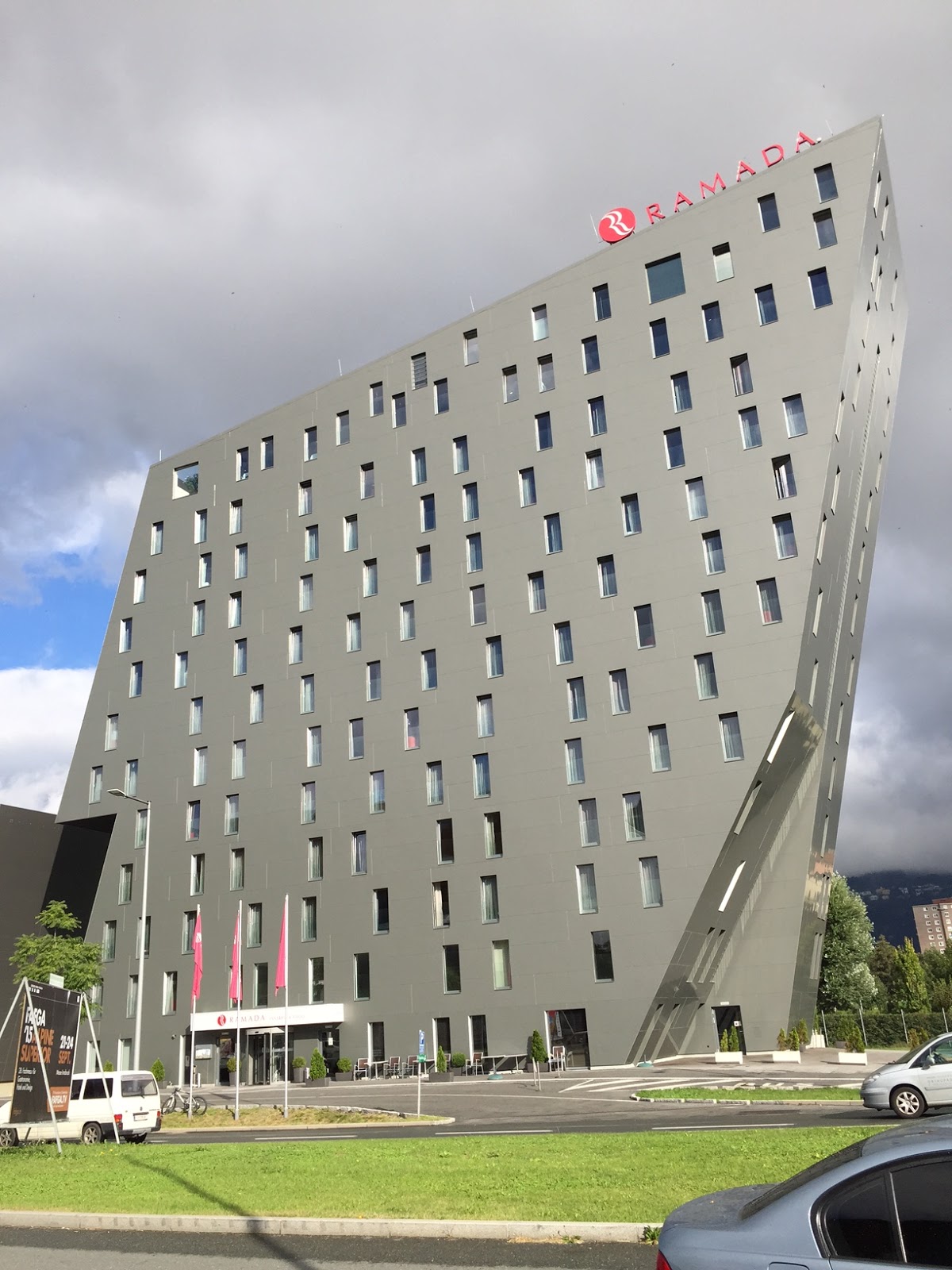
The following morning dawned with even better views of the surrounding mountains so I was soon out exploring.  In the darkness of my arrival I hadn't realised that the hotel itself was among the more unusual architecture around.


I'm sure there's a reason why it was built like this - it didn't resemble any of the other surrounding buildings - and it isn't simply the case that the architect's plans slipped while they were ordering the parts - but credit for originality.

A daytime view of the Olympic Hall showed it to be a classic of 1960s concrete, but it has aged quite well and still looks imposing and important today.


The subway linking the two was festooned with attractive and highly creative graffiti.  I can see arguments both ways on the merits of this kind of art, especially when there is private property involved, but it is difficult to see what harm is done by the creative decoration of a concrete municipal subway wall.  Especially when the artists clearly care deeply about what they are doing...


Just out of shot was a grumpy municipal notice saying that this wall was not to be painted on.  I know where I would pledge my allegiance in this case.

Of course the history of Innsbruck didn't start in 1964 at all, and after a healthy stroll into town I was able to take in the beautiful old town.  As indeed were several hundred tourists but somehow I managed to miss them all in this shot.  Popular place, and rightly so.


My enthusiasm for conventional sightseeing can be measured in minutes, and after roughly ten of those I wanted to try some transport.  I needed a day ticket for the municipal operator IVB and was able to obtain one from some of the cutest, most compact on-street ticket machines I've ever seen.  I'm not quite sure how I managed not to take a photo of one so you'll have to take my word for it, but they really were very nicely designed so as to offer a great range of tickets without taking up several metres of pavement.

However, for my first trip of the day I ignored the IVB network and jumped aboard the Hungerburgbahn.  This is the first in a linked series of funicular railways and cable cars that leads up into the Nordkette, the range of mountains immediately to the north of the city centre.

The Hungerburgbahn is a very modern style of funicular railway and climbs around three hundred metres (that's a thousand feet for the uncultured) above the city in about ten minutes.  The architecture is spectacular.  Initially the route starts in tunnel beneath the city centre, then emerges on to a spectacular bridge above the River Inn before diving down again then starting the precipitous climb to the upper station.

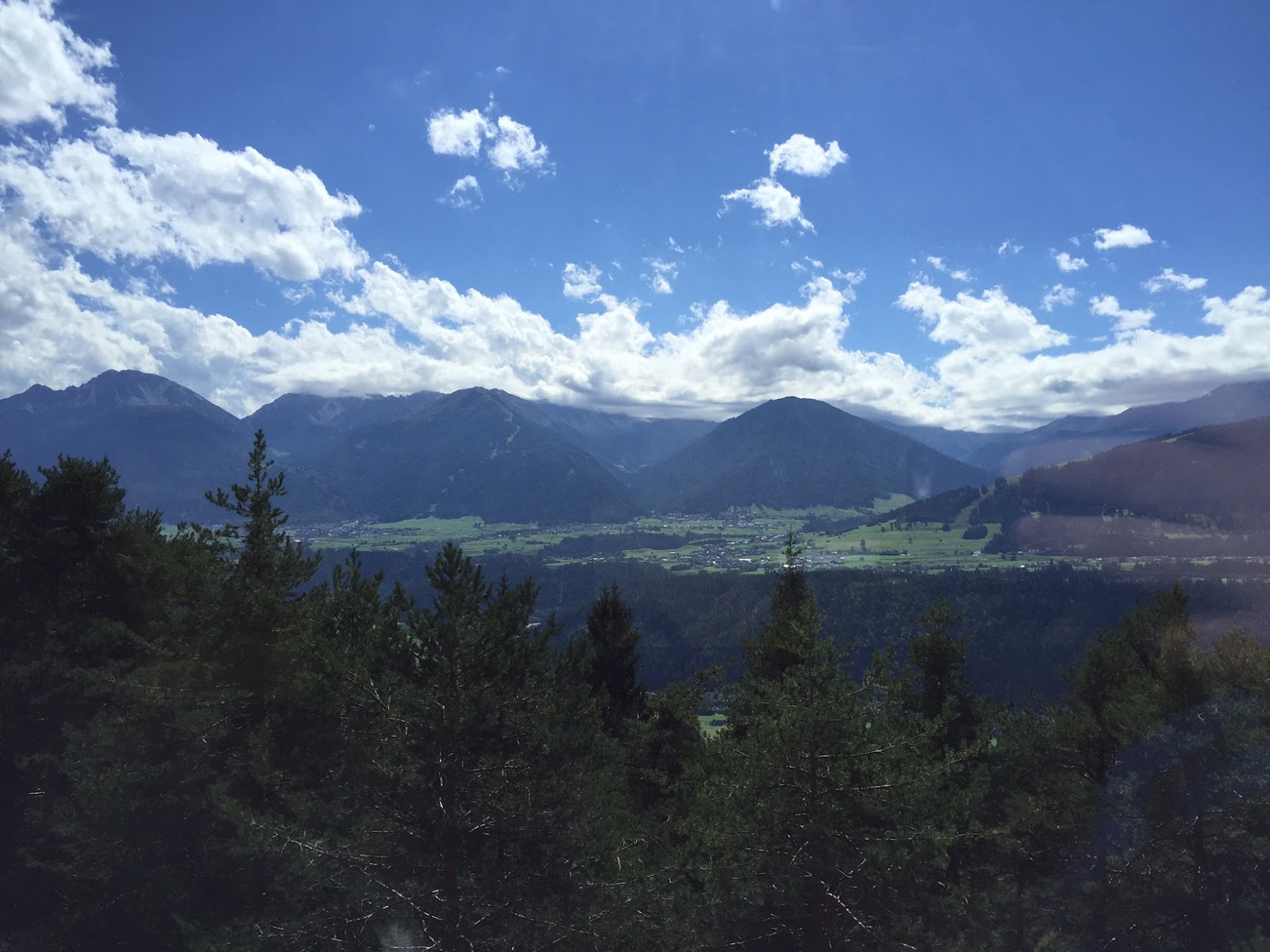
At this point, the views of the city become absolutely spectacular.


Further ascent is then possible with a series of cable cars, ultimately leading to a summit station 1700 metres (over 5000 feet) above the city, and I really wanted to do it.  But I was limited for time with a mid-afternoon flight back to the UK and I wanted at least one more trip somewhere, so instead I decided to transfer to the bus - the Hungerburgbahn station is also the terminus of city route J - and enjoy the descent back into the city by road.

This was a combination that had been recommended to me, and a fascinating excursion it turned out to be.  The route of the J was equally as spectacular as the funicular railway in some cases, and involves hairpin bends and tight village roads requiring some skilful driving.  But the route is traversed every ten minutes by standard issue twelve metre Citaros.  It has gone right to the top of my 'bucket list' of bus routes I want to drive!

Back in Innsbruck city centre, I was hoping that I might have time for a quick jaunt to the Italian border at Brennero, which would have allowed me to enjoy the railway up to the Brenner Pass.  But while there was a train just about to go, there would not be one to get me back in time for my flight, so that is now on the list for next time.

I had also been recommended to try the Stubaitalbahn, an eleven mile long narrow gauge tramway heading up into the valley below the Stubai Glacier.  But with a journey time of over an hour each way, time again was against me.

Arriving the previous evening, I had noticed what appeared to be a railway line cut into the side of the mountains high above the valley to the west of Innsbruck, and deduced that this was the line to Seefeld, Scharnitz and Garmisch Partenkirchen.  Having seen the mountains below the night before, I decided it was time to see the valley from above, and with a journey time of 35 minutes each way to Seefeld I just about had time.

For the plan to really work, it relied on me being able to make a two minute connection at Seefeld to get a train back the other way, but I inferred from the timetable that it must be a passing loop on a single track railway, so I figured there was a good chance it would work.  If it didn't, it wouldn't be a disaster to have to wait half an hour for the next one back, but would have made things slightly tighter than I wanted.

Very sensibly, and in a way that the UK has singularly failed to grasp effectively, but may be about to (hopefully voluntarily but I worry that it could equally possibly happen in the same way that turkeys sometimes vote for Christmas) transport in the Germanic countries generally works on the basis of common tariffs that cover all modes of transport within the selected zone(s).  When I asked for a return to Seefeld on the ticket machine, what I actually got was a day ticket covering the zones between the two, and it would have been nice to do something more creative than simply going out and back on the train but with limited time I didn't really have much choice.

The train was standard issue ÖBB urban stock and the route is numbered as part of the Innsbruck S-Bahn network.  The train was clean and comfortable but showing signs of needing some TLC - this was fairly typical of the seats I observed:


The line out of Innsbruck is indeed spectacular, swinging to the north of the main line a mile or two from the city centre before starting the climb up the north face of the valley.  I was delighted to get a bird's eye view of the airport...


...but things got really spectacular as we climbed further away from the city.


Of course, while I sat there turning into a dribbling mess of excitement at the unfolding panorama, the other customers were paying no attention at all.  After all, I wasn't on a premium tourist railway, but on a local suburban train barely twenty minutes from the centre of one of the country's main cities.  All around me were schoolchildren, shoppers and business people just going about their every day business.  They see this every day of their lives.  I'd love to know where they go for thrills, but this was the day that I learned the meaning of the word "jealousy"!

With a half hourly frequency in both directions, we were due to pass another train every fifteen minutes or so, and sure enough on each occasion the opposing train presented itself at the passing loop at exactly the same moment as we did so that we could proceed after only a very brief station stop.  Then, just as I was admiring the skill that must be involved in keeping this going all day, every day, another passing loop appeared and we passed a freight train, somehow slotted in between all the passenger movements.  To work a single line with this intensity requires an operating discipline that would be the envy of many other countries.

I began to worry whether I really would have enough time to double back at Seefeld, especially if I had to cross to a different platform, but in the end the southbound train was advertised with a one minute delay.  This gave me time to pop my head out of the station, confirm that it was indeed the manufactured skiing town that I remembered from a 1980's skiing holiday (where I learned that mountains are best viewed from anywhere other than on a pair of skies) and then rush back to the platform.

The return train was billed an InterRegio Express rather than S-Bahn, so I was looking forward to something a little grander in the way of rolling stock, but it turned out to be identical.  The IRE designation appears simply to refer to the fact that otherwise standard suburban trains cross the German border to Garmisch-Partenkirchen every two hours.

Due to the closure of the main German - Austrian rail border crossing point at Kufstein, this train offered a more interesting mix of passengers, with several luggage-laden tourists having clearly been sent this way rather than via the normal express routes.  While sharing my awe at the scenery, they appeared to be completely bamboozled by the unexpected change to their itinerary.  Having fallen into my usual trap of "person who looks like I know what I'm doing", one of them asked me a question and before I knew it I was well and truly making my contribution to the Innsbruck Tourist Board (if such a thing exists), dispensing advice on onward travel and general city orientation to a gradually growing audience.

Back at the main station I had to leave them to fend for themselves, as it was airport time.  Taking advantage of a peculiarity of the city centre route network, I was able to catch a tram for three stops, just for the sake of doing it, then transfer back to a Citaro artic on route F to the Airport that had left the central station just before the tram.  Well I thought it was fun anyway.

The driver wasn't having as much fun however.  Having joined the bus, we did a driver change and even though the new driver had barely got in the cab, he was immediately set upon by two English tourists demanding singles to the airport and proferring a high denomination Euro note.  To make matters worse, his ticket machine didn't want to play and the touch screen clearly was not responding to touch.

Keen to keep us on schedule, he set off through crowded city centre roads, with the two tourists hanging on for grim death and the driver paying more attention to coaxing a response from the ticket machine than the small matter of the road ahead.  After three or four minutes he was finally able to dispense the tickets and after a further small eternity while he amassed enough change, the whole bus was able to breathe a sigh of relief as he was finally able to take in the view through the windscreen, allowing us to stop almost mowing down pedestrians and driving through red lights.

It's one of those tricky situations where of course he should look after the customer, and unfamiliar users presenting high value notes are par for the course on an airport service.  But equally, the two customers did as much as they could to make his life as difficult as possible and a little more sensitivity really would not have gone amiss.

Anyway, we made it safely to the airport, and a departure lounge with views across the apron which must rank as some of the best departure lounge views anywhere in Europe.


This of course is the view back towards the railway line that I used earlier in the day towards Seefeld, and I find myself in awe of how anyone managed to construct a railway line through that kind of terrain.

You will gather from all the above that I have truly fallen in love with Innsbruck, and I can't wait to go back and explore more of the city and indeed the rest of the country.

From a transport perspective, the magic of Innsbruck is all about the scenery and topography.  It's not somewhere to go if you like myriad different liveries.  The railways are mostly standard-issue ÖBB stock, the buses heading out of town are all Postbus and the IVB buses and trams are either all silver or all red (I surmise that the red is replacing the silver, as it appears on all the newer stock).  In common with many European municipals, IVB lacks flair, but appears to do a decent job with mostly a high level of professionalism and the vehicles are superbly presented.  Beyond that, there is not much variety, but then the stuff worth looking at is all outside the windows!


Easyjet soon arrived to take me back to the UK, but not before one of the most convoluted boarding processes I've ever seen on a low-cost flight.  The plane parked within touching distance of the terminal - it would have been a shorter walk than I've experienced at many UK airports.  But we were all required to board buses.  After arriving passengers were disembarked, priority boarders were loaded on to one bus which set off and then drove round three sides of a square to park on the tarmac, adjacent to the steps leading to the aeroplane but barely a bus length from the back of the second bus, which was by now loading us non-priority passengers

Eventually we had a full bus, which didn't move but instead sat there with us staring at the priority passengers sitting in the other bus, and in the other direction the non-priority customers who wouldn't fit on our bus, staring at us from the terminal building.  Presently, the priority passengers were allowed to board, and their bus - now empty - pulled forward to form a line behind our bus, probably not having engaged second gear to do so.

But there wasn't quite room so we pulled forward half a bus length, and then sat there and waited while they filled the second bus with the remaining non-priority passengers.  Both buses then drove round three sides of the same square in convoy, dropping us off at the bottom of the steps less than a minute after setting off, but fully twenty minutes after we had got on our bus.

This all meant that all us non-priority passengers - around 180 of us I counted - arrived at the aircraft at exactly the same time, meaning that boarding then took nearly a further ten minutes.  All of which meant that we missed our air traffic control slot, and had to sit going nowhere for twenty minutes waiting for another slot to become free.

About the only endearing part of the whole process was the fact that the airport appears only to have one bus of its own, so the second bus on airside duties was a standard-issue IVB Citaro artic, complete with ticket machine.

The flight itself was mostly uneventful, although some lively cloud formations as we crossed the English coast caused some very exciting turbulence and a very roundabout tour of Kent before we landed at Gatwick.

It seemed to take nearly as long to walk through Gatwick Airport as it did to fly from Austria.  The walk from the Easyjet stands to Border Control is no small feat, enlivened only by going over the rather funky footbridge over one of the taxiways, and when we arrived at Border Control we joined a twenty minute queue.  Now yes, I know, national security etc, but what a really rude and unhospitable way to welcome people to our country.  Makes me ashamed, frankly.  Twenty minutes just to get to show a passport.

When I finally made it to the front, my passport wouldn't open the electronic gate, so I was directed to a dour-looking bloke sitting in a booth to one side, who held my passport under his own scanner for an eternity before cracking a grin and declaring "dodgy chip, mate" with all the barely concealed glee that one normally only sees from a bus fitter when declaring that a repair is "not a five minute job, mate".  Nothing better than spoiling someone's day.  It's a brand new passport and it worked fine in Frankfurt.  But I decided not to pick a fight and in turn, they kindly let me in.

The Border Force didn't have the monopoly on getting one over on the customer though.  The final leg of my trip was entrusted to National Express, to take me back to Heathrow to reunite myself with my car.  Nice coach, to be fair, calm ambience, plug sockets, wifi and a lovely relaxing early evening journey round a surprisingly empty M25, with soothing music in my headphones and plenty of room to spread out.   I'd do it again in a heartbeat.


The only fly in the ointment was the driver, who had clearly graduated with an honours degree in self-importance from that secret school that only a minority of coach drivers seem to find.  Communication to customers took the form of commands and instructions, not requests.  The customer boarding before me - clearly foreign and bewildered - was given a stern lecture for some luggage irregularity that I failed to catch.  When a customer had the temerity to attempt to sit on the nearside front seat, I think everyone in the coach station heard the battle cry, "can't sit there love".  No attempt to explain, or ask politely.  Do as you're told.

A minor issue in the grand scheme of things, and certainly in the context of a brilliant couple of days, in which I felt totally comfortable and at home in a beautiful city that I can't wait to revisit.  I have always had an ambition to live and work in Continental Europe.  Perhaps I should persuade my bosses that Wellglade needs a European office!

After such a relaxing coach trip, and with the time barely 8pm, I decided that of course it was far too early to drive home, so I forced myself to end my trip with another dinner overlooking the northern runway at Heathrow.

With at least three weeks until my next European jaunt (anyone for Busworld?) I'd better think of something more serious to write about next, but in the meantime it would be churlish of me to finish without acknowledging the help of Helmuth Schröttner of Reading Buses fame, who is a native of Innsbruck and provided me with a number of key suggestions about how best to use my time there.  I owe him several pints!

Sunday, 27 September 2015

Austrian Adventure - Part 1

Through my involvement with trentbarton, I have become familiar with the range of ticketing equipment produced by INIT.  Having driven a few shifts for trentbarton, I find their machines to be streets ahead of any others I've used in terms of their features and ease of use for drivers, and the transaction data available behind the scenes has been hugely helpful in planning recent service changes.

Within the management team of trentbarton we have been developing some very exciting ideas about how transport ticketing might evolve over the next few years and I was therefore delighted to have the chance to join a number of colleagues on a trip to meet INIT at their headquarters in Karlsruhe, Germany, and talk through our ideas.  Of course it's far too early to reveal what we discussed - other than to say that it will hopefully turn into something very exciting - more of that anon.

But I decided to tag on a couple of days' leave and go travelling.  Although I have travelled fairly widely in Germany and been through Karlsruhe many times on trains, I have never visited the city and in general I have neglected the southern part of Germany.  I also wanted to revisit Austria after many years' absence, and in particular wanted to visit Innsbruck - another city I have never previously explored.

Other more insightful, cutting edge blog posts may be in store, but this one is nothing more than a report of my trip and some pictures to look at.

My interest in transport extends beyond buses and trains and indeed I am an aviation freak - especially when it comes to commercial flying.  I am one of not many people who visits airports for fun.

A prior engagement down south meant that whereas my colleagues would be flying from Birmingham, I would fly from Heathrow and meet them in Germany.  I was secretly delighted by this as it gave me an opportunity to stay in an airport hotel and indulge my big kid obsession with the aeroplanes.  So while my colleagues were getting an early night ready for 4am alarm calls to drive to the airport, my trip started with a relaxing evening in the restaurant of the Thistle Hotel, enjoying dinner and a glass of wine while watching a stream of British Airways planes heading to and from Terminal 5.

The Thistle boasts that it is the only off-site hotel to be linked directly to Terminal 5, and the link is provided by automated pods.  These funky little devices whizz around a network of tracks linking the terminal with its car parks and provided a novel way of starting my trip - compensation for the very early start.


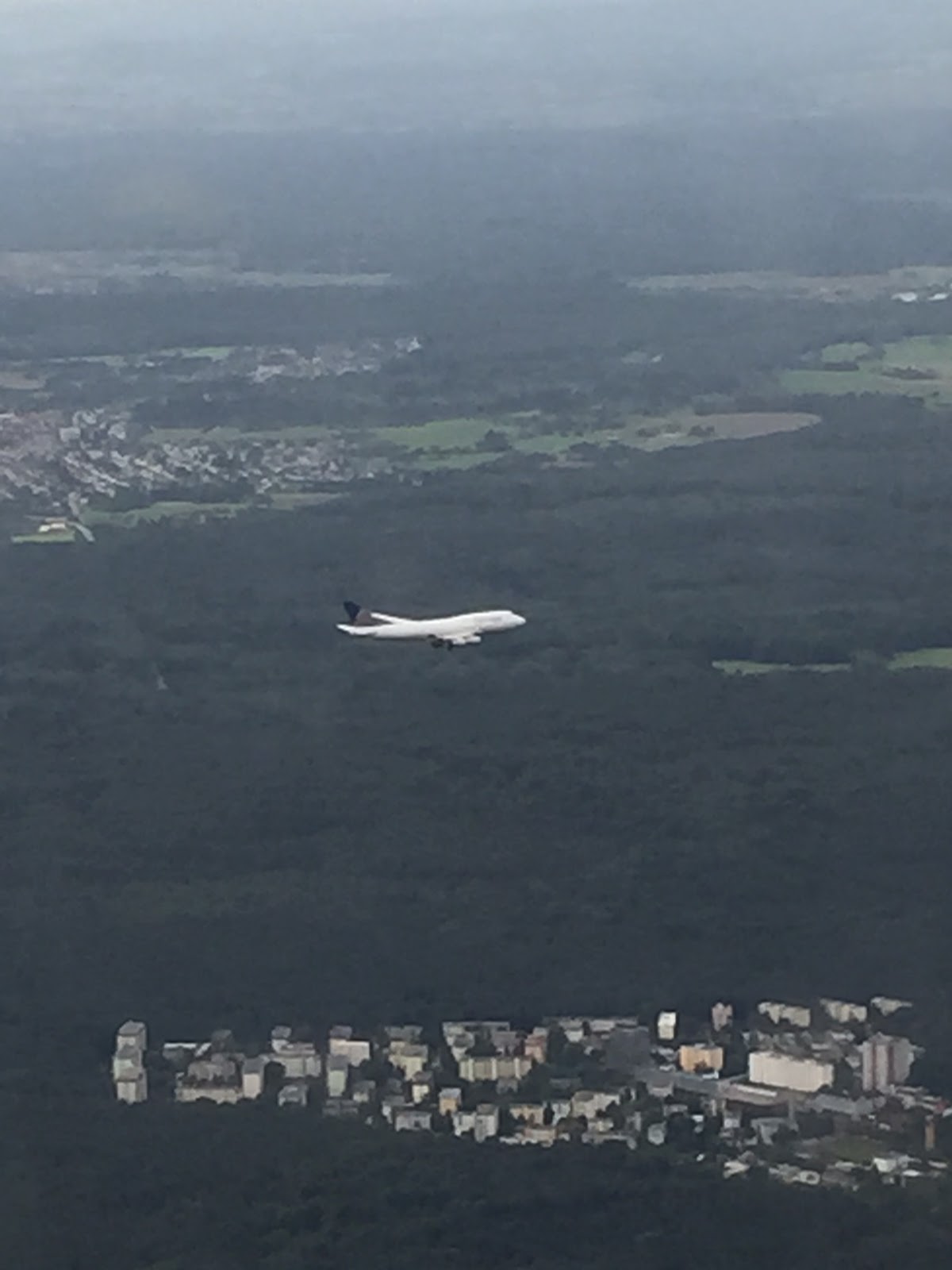
My flight to Frankfurt was on a British Airways Boeing 767, great excitement for me as I have never been on one of them before, and very comfortable and spacious it turned out to be.  Most of my recent air travel has been with the low cost carriers so as well as luxuriating in acres of legroom I was quite surprised to get free food, and the cheese and ham croissant certainly went down well.  Soon we were approaching Frankfurt, where we found ourselves making a parallel approach with a United Airlines Boeing 747, which made a very graceful and elegant sight as we flew alongside for ten or fifteen miles.  Rare indeed to get such a good view from above.


Our trip to Karlsruhe was by ICE, all very smooth and straightforward, and the afternoon yielded excellent hospitality and very productive discussions about the future with INIT.

Karlsruhe celebrates its 300th birthday this year and every night over the summer they have been holding sound and light shows at the castle.  Our hosts insisted we should see this, and they were absolutely right, it was stunning.  Huge projectors lit up the whole frontage of the building with incredible lighting effects and patterns, all set to music.  No good me trying to describe it here - there's no way you can experience it without seeing it - but it warrants a mention because it was absolutely superb.

The city is famed in transport circles for its tram-train network.  The main station is some distance from the city centre so much of the suburban rail network is provided by tram cars, which then head off the rails and on to the tram lines as they come into the city so they can serve the city centre.  Impressive and clever, and I was quite surprised by the extent of the system, with trams operating twenty or thirty miles into the hinterland.  A tram-train system is currently being developed for South Yorkshire, albeit with rather more modest ambitions at this stage, but I look forward to seeing that materialise.

For the record, here is a tram:


It should be said that this tram wasn't going very far at all, and was just running on the city network. 

Having finished our business early on the second day, we had a few hours to kill before the others went off to catch their flight.  The tram nearest to INIT HQ was line 5, and the destination "Rheinhafen" effectively means Rhine Port.

One exciting feature of the German transport network is the extensive use of the river for transporting freight, and one can stand on the banks of the Rhine and watch a constant procession of river barges.  The prospect of having an actual port right by the tram line was too exciting for a transport nut like me, so I persuaded the others that we should stay on the tram right to the end of the line just to see if we could get a grandstand view of the port activities.  It was raining, so they agreed.  But sadly the line petered out in the middle of a labyrinth of motorway sliproads, so we caught the next tram back into the city and passed away the time drinking beer instead.

There is a huge construction project underway in Karlsruhe at present, apparently to place the tram lines underground, and this means that large parts of the city centre are being dug up.  Clearly this has implications for property in the affected areas, but it seems some people are willing to go to great lengths to avoid the loss of old buildings - we had to question how many beers we had consumed when we spotted this rather literal interpretation of the concept of moving house...


Karlsruhe hotels appear to be both expensive and in short supply, so once the others had departed back to Frankfurt for their evening flight, I caught a train the short distance south to Rastatt, where my hotel room was not only much cheaper but overlooked the main railway line heading south to the Swiss border, which gave me a grandstand view of a continual stream of freight trains, ICEs and tram-trains.

My plan for day three was to cut across the south side of Germany and into Austria.  Although it doesn't look that far on the map - a mere 200 miles or so as the crow flies - the topography makes it slow going, and the "direct" route via Stuttgart and Ulm didn't hold much attraction for me as I have been that way before, and I was all about the scenery.

I have never explored the Black Forest, so the first leg of the day was a long train ride from Rastatt to Konstanz through the heart of the mountains.  This promised to be a hugely scenic ride, and indeed I'm sure it is.  However, it was raining hard all morning and the cloud base was low.  It was hard enough to see anything at all through the rain-smeared train windows, and such scenery as was visible disappeared very quickly into the murk and gloom.

However, I saw enough to be convinced that it ought to be a stunning journey, and I will simply have to go back.

The entire morning was consumed staring at mist and cloud, so it was a relief when the rain cleared as we arrived in Konstanz.  This is a tourist town, on the banks of Lake Constance (Bodensee to the locals).  The town itself holds no particular appeal for me but the location is superb, with stunning views across the lake.


Konstanz is adjacent to the Swiss border - indeed there is a customs post (unmanned of course) - halfway along the platform at the railway station.  Such is the interaction of the various transport systems that Swiss local trains provide local rail services entirely within Germany, as seen here:


The lake itself has shorelines in Germany, Switzerland and Austria, and as a keen Europhile I am in my element here.  Current events meant that the question of national borders was very much the hot topic of the day in the news, but I love the fact that people move seamlessly between adjacent countries in the course of their daily lives and the borders themselves are irrelevant.

In planning the trip, I had been frustrated by the fact that all the rail routes around the edge of the lake were time consuming or involved long detours and I was keen to complete the trip in daylight.  It had therefore been a revelation when I realised that the answer wasn't to go around the lake at all, but across it, taking advantage of an hourly link between Konstanz and Friedrichshafen provided by Der Katamaran.  There is quite an extensive network of ferry and catamaran links criss-crossing the lake, but many of them appear to cater for the tourist market with just one or two sailings per day.  This on the other hand is an all day every day link for commuters and shoppers as well as visitors, and my lunchtime journey had a reasonable load of business travellers.  The fifty five minute crossing provided a very relaxed and civilised interlude to the day, on a very comfortably appointed vessel offering plug sockets and free wifi as well as an extensive offer of refreshments from a well appointed bar.  Highly recommended.


By the time we arrived in Friedrichshafen persistent rain had once again set in, to the point where it was uncomfortable to walk around.  It looks like an attractive, compact town that will warrant a repeat visit - not least for the chance to have a nose round the Zeppelin Museum and Dornier Museum.  But I hastened to the main railway station looking forward to the main event of the day, the InterCity train to Innsbruck through the Arlberg mountains.

Twenty years ago, when I was discovering Europe on my own for the first time, Germany and its surrounding countries were covered by an extensive network of loco-hauled InterCity and EuroCity trains.  All of them named, often following long, highly improbable itineraries that would wend their way from one side of the continent to the other, usually taking all day to do so.  Careful scheduling meant that these trains would dovetail to provide absolutely unwavering hourly or half hourly frequencies between main towns and cities, but each individual train would follow a unique route.  Often the trains themselves would comprise a wide variety of coaching stock assembled from the various countries it served, and it was not at all unusual to see four or five different types of coaching stock in the same train.

Much of this network has been swept away now to be replaced by high speed trains operating as fixed units, offering consistent journey patterns on standard routes.  While this provides a very good offer for the day-to-day user, for the transport enthusiast it means that much of the character of inter-city train travel has been lost.

Some such trains do still remain however, and I had been delighted to discover that there is one direct link a day between Friedrichshafen and Innsbruck, provided by a train which originates in the north German town of Münster and gradually heads south on a long, winding twelve hour itinerary.


I had about an hour to wait and the monotonous rain was at least partly relieved by some variety in the local transport scene.  As with many parts of Germany local train services are contracted out to private operators by the regional transport authority.  Around Friedrichshafen, the local trains are called BOB (that's the Bodensee-Oberschwaben-Bahn of course - it rolls off the tongue).  There was also an appearance from one of the many low cost long distance coach operators that have sprung up across the country in recent years, proving that a lime green waistcoat is a must-have fashion accessory for any discerning coach driver.


When the InterCity train finally appeared, it was well worth the wait - a long rake of ÖBB coaches hauled by a pair of 1970s diesel locos.  Real throwback stuff and hardcore train porn. 


To compound the excitement, the train reverses at Friedrichshafen so we were treated to the locos running round the train.

The journey itself was glorious.  After a fairly mundane twenty minute run to Lindau, where the Austrian ÖBB locomotive was attached and our German DB locos left behind, the rain eased off a lot and the mountain scenery became spectacular as we made our way through the Arlberg into Austria.  It is hard to describe a journey like this with sufficient superlatives, there really is nothing nicer than relaxing in a train seat and watching some of the world's most glorious scenery drift past the window.


Operationally it is easy to see why such trains have become an endangered species.  Several reversals and loco changes must make them hellishly expensive to operate, yet the train was probably between a quarter and a half full when we left Friedrichshafen and certainly didn't get any busier.

The rolling stock itself seemed quite tired and the customer service wasn't top notch either.  I joined the front coach, which became the rear coach at Lindau, and we were all ordered to move into the next coach because ours would not be continuing.  Then when the Austrian crew came round shortly afterwards everyone going beyond Bludenz was instructed to move two coaches further forward.

The idea that all the coaches don't go all the way through to the destination is not unusual - European loco-hauled trains often do things like that.

What was frustrating is that when my ticket was first checked between Friedrichshafen and Lindau nothing was said, and I clearly wasn't the only one because the coach was about third full when we were told to move, and the tone of the guard was as if we should have known.  And when we were moved, we could have been told to move three coaches rather than settling down and being moved again.  Either way, to be moved once is mildly annoying, twice smacks of incompetence.  And then to compound it all, when we arrived at Innsbruck three hours later, all three coaches were still attached to the train, just locked out of use.  Presumably there must be a reason for that but I'm struggling to think of what, beyond a tiny saving in electricity.  Perhaps someone can tell me the answer.

We nearly didn't arrive in Innsbruck at all.  Shortly after passing into Austria, we were informed that the line was blocked due to overhead line problems at a place called Flirsch (other people's railways do have the same problems as ours!).  We were held for fifteen minutes at Bludenz and then a further forty five minutes at St Anton Am Arlberg awaiting further information.  I could deduce from careful interpretation of the live train info on the ÖBB website that the train before ours had been terminated there and the passengers taken forward by coach.  Not that that would have been a particular problem - the journey would have been equally scenic and the journey time maybe even quicker.  But I had a great seat with a panoramic window view and I didn't want to give it up!

Luckily I didn't have to.  The problem was resolved.  We continued, an hour late but that wasn't a major problem for me.  The journey was everything I hoped it would be and more, and I can't wait to do it again.

The delay meant that we arrived in Innsbruck as it was getting dark.  So after admiring everything the bus interchange outside the station had to offer, I decided not to go sightseeing and headed for my hotel.  The route took me about fifteen minutes on foot, through some of what we would euphemistically call "good bus territory" with some interesting characters of the kind that only seem to emerge after dark.  Some people might have found that off-putting but I was really happy - at large and off the beaten track in a foreign town.  Pretty soon I was ensconced in the Ramada Innsbruck Tivoli and looking forward to a day discovering Innsbruck...


Onwards and Upwards

What's two years between friends?

Since I last wrote this blog I have sold my bus company, taken up permanent employment at Wellglade and moved to Nottinghamshire.

It was never particularly my intention to stop writing but things have been busy to say the least.  And at times a bit traumatic.

The sale of Velvet was the dominant theme of 2014, proving to be a difficult and protracted process.  The story didn't end with the sale either.  As has been well documented, the new owners took the company in a disastrous direction and sadly it met its end earlier this year.  One day I might write the story of Velvet, not least because it is important to keep in mind that we had five very happy years that were memorable for all the right reasons, but that is not for now.  There are still too many things that I cannot say at the moment, for legal reasons or simply to protect the sensitivities of those who have been affected by the demise of the business.

For now, it is onwards and upwards as I embrace my new role as Group Development Director for Wellglade, the group best known for trentbarton buses but also incorporating TM Travel, KinchbusNotts and Derby and Kleanline, as well as being joint owners of High Peak with Centrebus.  Indeed, one of my responsibilities is to sit on the Board of High Peak on behalf of Wellglade, albeit not involved in the daily running of the business.

For the most part, I divide my time between running TM Travel, for which I am now wholly responsible, and providing support to the rest of the group - predominantly trentbarton - with commercial and business development projects.

As an interesting sideline, I have also assisted in the creation of a new company - Find My Bus Ltd - set up by web developer Joel Kidd to produce apps and websites for smaller and independent companies.  Joel designed the Velvet website and realised that there was a gap in the market where smaller companies want to be able to offer their customers technological solutions on a par with, or better than, those offered by bigger organisations, but unable to afford the huge one-off costs usually involved in the creation of apps or websites.

These sites exploit a standardised template design, easily customised for the individual operator, to provide a solution at much lower cost than would be necessary with a bespoke implementation.  Cash flow is a critical factor for smaller operators, so payment is on the basis of a monthly subscription model rather than a huge up front payment, and this in turn allows the operator to benefit from improvements and upgrades as they are developed.

TM Travel customers have been able to benefit from the smartphone app for around a year now, and it is on the point of being unveiled for University of Derby students.   The key feature of the app is the ability to track the location of buses in real time, following them on the map as they drive along the road.  Customers tell us that they find this a massive benefit in having the assurance that the bus is definitely on its way and how it is doing compared to schedule, and it gives them greater confidence than a 'traditional' real time countdown, which is based on predictions which can prove to be wrong.

This has been a very exciting project indeed and there are numerous customers in the pipeline having their sites and apps developed, and of course we'd like more!

Meanwhile, one of the benefits of no longer controlling buses in Eastleigh on a Saturday is that I find I have more opportunities to get frustrated at football matches and this season I have splashed out on a season ticket for my beloved Luton Town.  The travelling can be a bit of a chore - living in Hucknall it's a full day out - but it's good fun and I'm hoping that when we romp to promotion next spring it will make it all worthwhile!

Various people at various times have told me I should resume this blog, and now that I'm out of the legal morass associated with the demise of Velvet and I'm in a new groove, it should be much more achievable.  Chatting to an industry colleague a couple of weeks ago, I explained that part of the reason for not writing is because so much of what I do is commercially confidential - and I certainly won't be saying anything here that breaches any confidences - but the more we discussed it, the more I realised there is plenty of stuff I can write about that some people might hopefully find interesting, so let's see how we go.

But for a nice gentle start, I might indulge in a modest travelogue, a brief report of a recent trip to Germany and Austria...

Monday, 18 November 2013

Bus running late? Grab a coffee!

Sometimes the simple ideas are the best, and this moment of inspiration from my Velvet colleague Mikey deserves a mention.

At this time of year rush hour traffic doesn't need much help to be a nightmare, but last Thursday was especially bad.  A combination of factors meant that it was taking buses on the A around two hours to complete the scheduled 75 minute journey from Eastleigh to Southampton, on a freezing cold night.

Mikey was in the office watching the tracker, monitoring the slow progress of buses around the network and tweeting regular updates to the world.

One trip was causing us particular concern, the 1645 A from Eastleigh to Southampton which was due to return as the 1810 from Southampton.  As this bus passed through Hedge End on its way into Southampton, some time after it should have left to come back, Mikey tweeted this...
Velvet A: Customers waiting for 1810 from Soton - H'End, get in the warm, grab a coffee, keep the receipt and driver will reimburse the cost
This was done without any prior consultation, discussion or planning, just an idea from Mikey in that moment to try to minimise people's pain.

And the best bit is, some people did exactly that.  They went and got a coffee, and our driver Martin reimbursed them.  Mikey had texted Martin when he made the decision and luckily Martin picked up the text when he was in town.  But Mikey was confident that even if he didn't, the worst that would have happened would have been Martin phoning him to try to understand why people were presenting him with coffee receipts.

As with most customer service initiatives, it is impossible to quantify the exact benefit of that decision, but at the very least it hopefully helped reassure some of our regulars that we certainly do care about them and will do our best to look after them even when things are going wrong.

I am lucky enough to be present at the UK Bus Awards tomorrow (not winning anything I might add). But for me, that kind of split-second customer focussed decision deserves an award in itself!